
July 28, 2026
Is the Trump Administration not Granting Billions in Funding for Big Transit Projects?
UPDATE | Aug 10, 2026
The Trump Administration (U.S. Department of Transportation’s Federal Transit Administration) on August 7th, 2026 announced that it had approved the FrontRunner 2X project to enter the engineering phase of its Capital Investment Grants program, allowing Utah to begin spending money on construction that can be federally reimbursed as it awaits a final decision on whether it will receive the full $1.28 billion investment from the FTA’s Capital Investment Grants (CIG) program for Utah’s FrontRunner 2X Commuter Rail Project.
This is the first CIG grant announcement in about 20 months since President Donald Trump took office for his second term in 2025, an unusual gap from the last several previous administrations, including Mr. Trump's first term in office, Jan 2017— Jan 2021, which had two CIG grants awarded, the same as President Biden's first year and President Obama's first year.
Once complete, the multi-billion FrontRunner 2X Commuter Rail Line project will increase the availability, frequency and capacity of commuter trains by at least 60% along the 82-mile FrontRunner rail that services 16 stations from Ogden to Provo. This follows the New York Times reporting on July 27th that since President Donald Trump returned to office, the Federal Transit Administration (FTA) had not signed a single new agreement under the program known as Capital Investment Grants.
New York Times | Congress Budgeted Billions for Big Transit Projects. Trump Isn’t Spending It.
By Emily Badger and Alicia Parlapiano | July 27, 2026
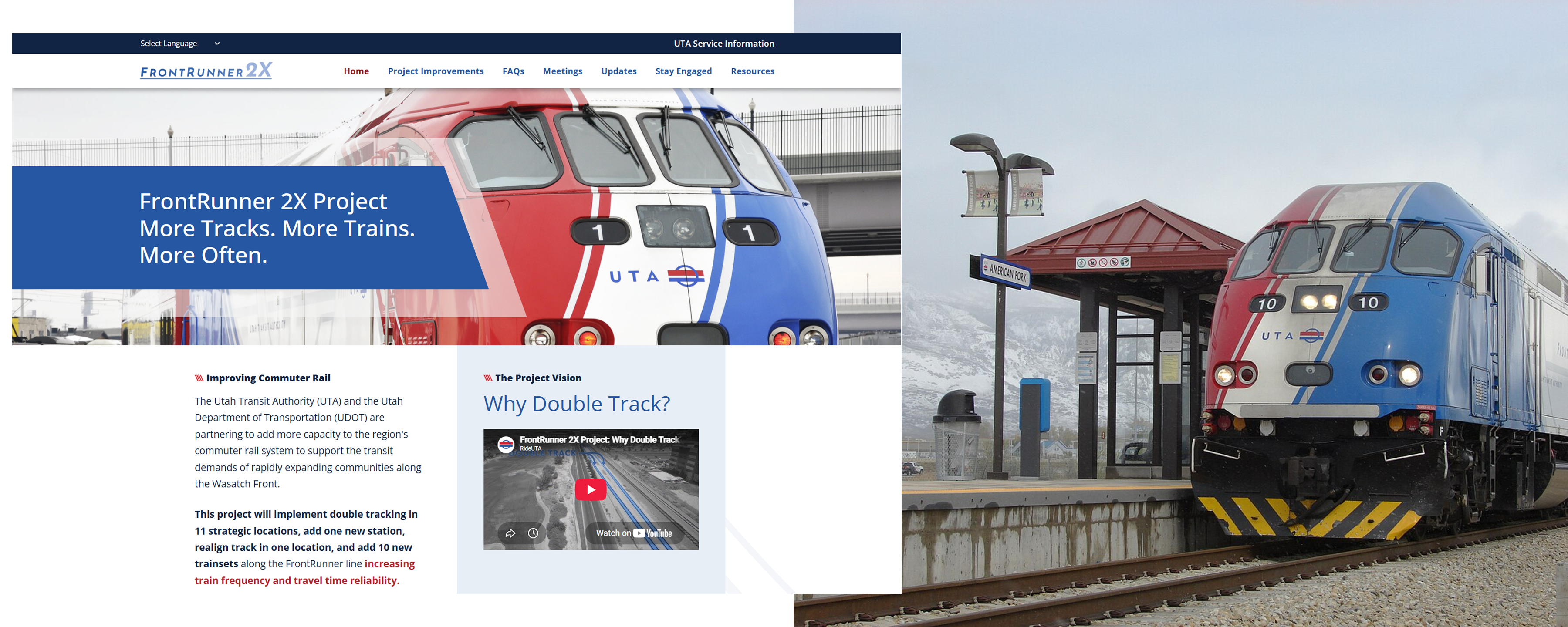
ABOVE: The FrontRunner 2X Project in Utah is one of several large rail transit projects in the FTA's Capital Investment Grants' approval pipeline. PHOTO CREDIT RIGHT: 'An Errant Knight' via Wikipedia
NEWS & OPINION PIECE by ESPA Vice-President Benjamin Turon
Capital Investment Grants
The New York Times is reporting that since President Donald Trump returned to office, the Federal Transit Administration (FTA) has not signed a single new agreement under the program known as Capital Investment Grants.
Capital Investment Grants is an FTA discretionary grant program that funds transit capital investments, including heavy rail, commuter rail, light rail, streetcars, and bus rapid transit. Federal transit law requires transit agencies seeking CIG funding to complete a series of steps over several years.
For ‘New Starts’ and ‘Core Capacity’ projects, the law requires completion of two phases in advance of receipt of a construction grant agreement: Project Development and Engineering. For ‘Small Starts’ projects, the law requires completion of one phase in advance of receipt of a construction grant agreement: Project Development.
The law also requires projects to be rated by FTA at various points in the process according to statutory criteria evaluating project justification and local financial commitment. The FTA reviews engineering plans, environmental assessments, ridership and cost data and local funding commitments. Projects spend years in that review — some never make it to the end — and no money is guaranteed until an agreement is signed.
Examples of projects funded by Capital Investment Grants include:
- The New York Second Avenue Subway Phase 2 extension;
- The Chicago Red Line Extension project.
- The Hudson River Gateway Tunnel reconstruction and expansion.
- The Seattle RapidRide I Line rapid transit corridor.
- The Portland 82nd Avenue Transit Project and Interstate Bridge Replacement.
- Indianapolis IndyGo Red Line and Blue Line Bus Rapid Transit (BRT) projects.
- The Austin Light Rail, Phase 1.
- San Antonio VIA Metropolitan Transit Advanced Rapid Transit Green Line
According to the July 27th article in the Times, several large projects ready to enter the final phase of the program’s years long pipeline have stalled. More than $7 billion that Congress designated for Capital Investment Grants hasn’t been obligated to any project since the Trump Administration enter office for the President’s second non-consecutive term.
Projects affected include the in Utah the FrontRunner 2X project which is in the pipeline seeking a $2.4 billion grant. It would add parallel second track to sections of an 83-mile-long commuter rail, enabling more trains for more frequent service and more riders. Utah is up against a deadline to host the 2034 Olympics and needs to start construction of necessary transport infrastructure as soon as possible.
During the first year of President Trump’s first term with Elaine Chao as Secretary of Transportation, two such grants were approved, with thirty-two more over the next three years. That eighteen months have gone by without a single approval in the second term is raising concern among officials involved in public transit.
Negative impacts include approval delays compounding rising construction costs that are outpacing overall inflation. Without the certainty of federal funding, it’s harder for states, counties, and cities to pursue bonds and other financing for big projects.
The New York Times reports that the US Department of Transportation stated that the projects were simply working their way through the multistage grant process required by law.
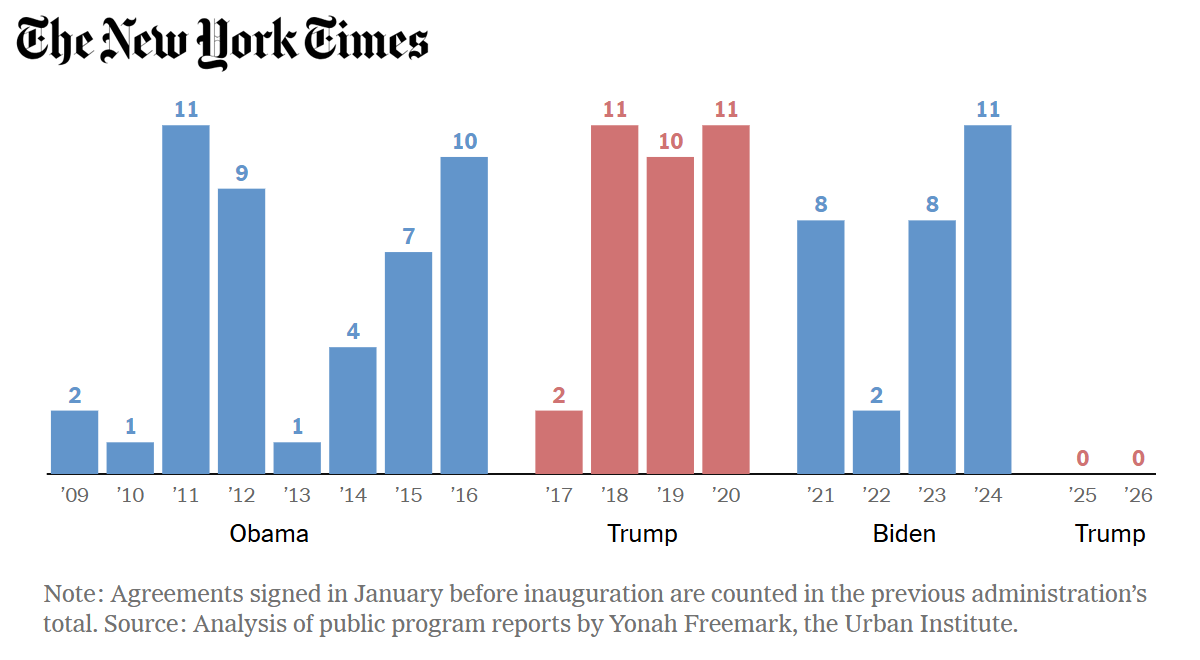
GRAPHIC SOURCE: The New York Times
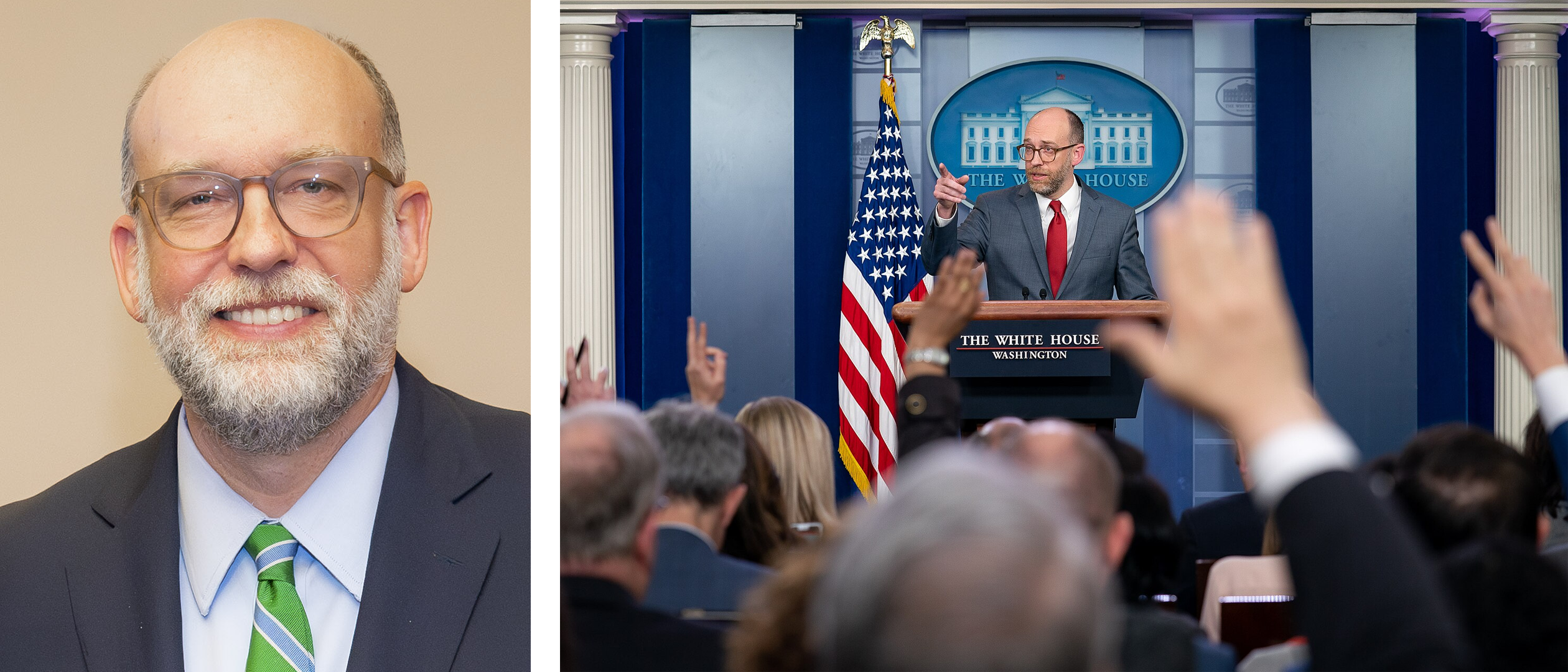
ABOVE: Russell Vought, the director of the Office of Management and Budget since February 2025 and a key contributer to the Heritage Foundation's 'Project 2025' political initiative; authoring the Mandate for Leadership policy document section and drafting a "transition playbook" for Project 2025 to be implemented by a Second Trump Adminstration within six months. IMAGE CREDITS: Wikipedia
Russell Vought Says: "Nope"
There are fears that the lack of grants is a “soft way” for the current administration to kill the program that in Mr. Trump’s first term they proposed eliminating; the US Congress having ignored this request and continuing to fund it.
Later the Capital Investment Grants made an appearance during the 2024 election season in the conservative thinktank Heritage Foundation’s policy blueprint and transition initiative ‘Project 2025’ as a poor use of funds, recommending that it be eliminated.
Project 2025 coauthor Russell Vought was deputy director, acting director, then Senate-confirmed director of the Office of Management and Budget (OMB) in Mr. Trump’s first term is now in the second back as the Director of the Office of Management and Budget.
Mr. Vought has already been at the center of halting payments to the Hudson River Gateway Program and the Chicago Transit Authority's Red Line Extension and Red and Purple Modernization programs. Federal court orders later restored federal funding to these rail and transit projects.
Project 2025 stated that if the Congress chooses to keep the program around during a second Trump Administration, that the executive branch should subject candidate projects to a “rigorous cost-benefit analysis.”
This would be the “soft kill” as "procedure fetish" was cited in the top selling policy book ‘Abundance’ by Ezra Klein and Derek Thompson as a key reason that why after four years the Biden Administration had little to show for the $1.2 trillion appropriated by Congress for transport and energy infrastructure funding from the Infrastructure Investment and Jobs Act (IIJA) and Inflation Reduction Act of 2022.
The posterchild example of this was the $42 billion Broadband Equity, Access, and Deployment (BEAD) program passed to bring affordable broadband internet to rural communities which included 14 procedural steps – with significant labor, environmental, and domestic-production requirements with initial planning grants, five-year action plans, map challenges, final plans, etc. – to actually get funding to internet service providers.
It required the Federal Communications Commission to complete a national map of where broadband is currently missing, the Commerce Department to distribute funding to states, state-level broadband offices to allocate subgrants to internet service providers, and the telecoms to deploy cables to connect homes to the internet. Many of these steps were added during congressional negotiations to please both Democratic and Republic lawmakers, consumer and industry groups.
Three and a half years after the law passed, shovels had not broken ground on any project funded by the federal program. Vice-President Kamala Haris running for the presidency could not visit any community in rural America and state: “You have broadband today (or soon) because of what we have done.”
Critics of ‘Abundance’ have pointed out that the story of rural broadband is more complicated and nuanced, that far less bureaucratic programs during the Trump, Obama, and Bush W. Bush administrations had also failed to deliver much; with large internet telecoms that often hold a monopoly in rural areas being reluctant even with public subsidies to extend broadband coverage to rural areas.
Still, it wasn’t the only example, the National Electric Vehicle Infrastructure (NEVI) program funded in 2021 was do build 500,000 charging stations, which due in part to a maze of numerous “everything bagel” requirements – from boosting labor standards to buy American requirements – only 15 had been built by Donald Trump’s win in November 2024, a point the current president ran home in speech after speech during his campaign.
If such proceduralism – ensuring every t's crossed and i's dotted – could slow money going out-the-door in an administration that wants the money to be spent, it’s easy to see how an administration opposed to spending the money can gum-up-the-works during the approval and awarding process so that in effect, no money is spent.
Just as the ultimate avatar of the “deep state” Sir Humphrey Appleby constantly foiled minister and then prime minister Jim Hacker in the BBC’s classic political satire “Yes Minister/Yes Prime Minister” – Russell Vought at OMB can and seems to very much be doing the same to congressionally approved and funded grant programs.
PHOTO CREDIT: Architect of the Capitol via Wikipedia
Congress Says: "Fund This Now"
Yet, the National Electric Vehicle Infrastructure program also offers a solution to the recissions, disallowance, and slow walking of infrastructure programs by this and future presidential administrations.
It turns out that Congress had written out the program in such specific detail while imbedding deep it into core spending programs, that despite President Trump on Inauguration Day announcing that he would freeze NEVI, it survived a court challenge and was reluctantly adopted by the administration.
In fact, the Trump Administration has arguably improved the NEVI program by relaxing the most burdensome requirements, while the national standards of a common set of rules and requirements for EV chargers established by NEVI – including a standardized universal payment system as a gas pumps – have stimulated the continual installation of charging stations by the private sector.
And so in my opinion, it can be going forward with transit and rail infrastructure funding, with Congress upping its game in the drafting of legislation so that an administration has no legal leeway of not fulfilling the wishes of lawmakers.
Congress should consider earmarking and block granting money for specific mega-projects and programs, to get money out the door faster and shovels in the ground sooner.
If Utah needs $2.4 billion for the FrontRunner 2X regional passenger rail project, Congress just writes that into the text of a transportation/infrastructure bill – leaving the executive branch’s only role after the president signs the legislation to that of sending the check to the state government.
This of course brings up the specter of good old-fashion “pork-barrel” spending. For people my age and older, many of us will remember US Senator John McCain's (Arizona) long crusade against earmarks.
Most egregious being those of fellow Republican Representative Don Young of Alaska, who earned the moniker "Mister Concrete". This included the “bridge to nowhere” in Ketchikan, Alaska and a $10 million earmark to build an interchange with Interstate 75 for Coconut Grove Road in Florida, a road which connected land owned by political donors of the Alaskan congressman to the interstate highway.
Yet, congressional earmarking could be done in an open process with oversight and transparency, as a response to an increasingly imperial presidency and a conservative Supreme Court that often goes by the letter of law, due to their ‘textualism’ of legal and constitutional interpretation.
If Congress writes into a law – spend x amount on x project, send the check to x by this date – it would be with exceedingly great difficulty by administration officals to legally argue against doing that on cable news or in federal court.
As the second Trump Administration takes a chainsaw to the state capacity – the institutional knowledge and manpower of the administrative state – with first Elon Musk with DOGE and Russell Vought’s less flashy yet more effective continual efforts, Congress could respond by building up the organizational capacity of the legislative branch.
Congress could create a new organization or task the Congressional Research Service, Congressional Budget Office, and the Government Accountability Office to vet projects submitted for inclusion in future transportation/infrastructure bills. Congressional staffers could take submissions from state agencies, endorsements from members of congress, governors, and mayors, submit them to cost-benefits analysis, and publicly publish the results.
Congress could also work with future administrations supportive of transportation spending to compile a list of projects, doing sp to prevent a following adminstration from defunding them. Historically dams and levees included in federal Flood Control Acts were recommended to Congress by the Army Corps of Engineers, who have long been tasked with maintaining navigation and flood control infrastructure of many of the nation's waterways.
Both political parties could also create in-house versions of the American Legislative Exchange Council – a nonprofit organization of conservative state legislators and private sector representatives which drafts and shares model legislation – to professionally draft legislation, do research and analysis, and include internal party checks on proposed earmark funding.
Block granting money directly to states based on some widely agreed upon formula taking into account population and gross-domestic product is also another end run to an administration giving congressionally approved spending the go-around.
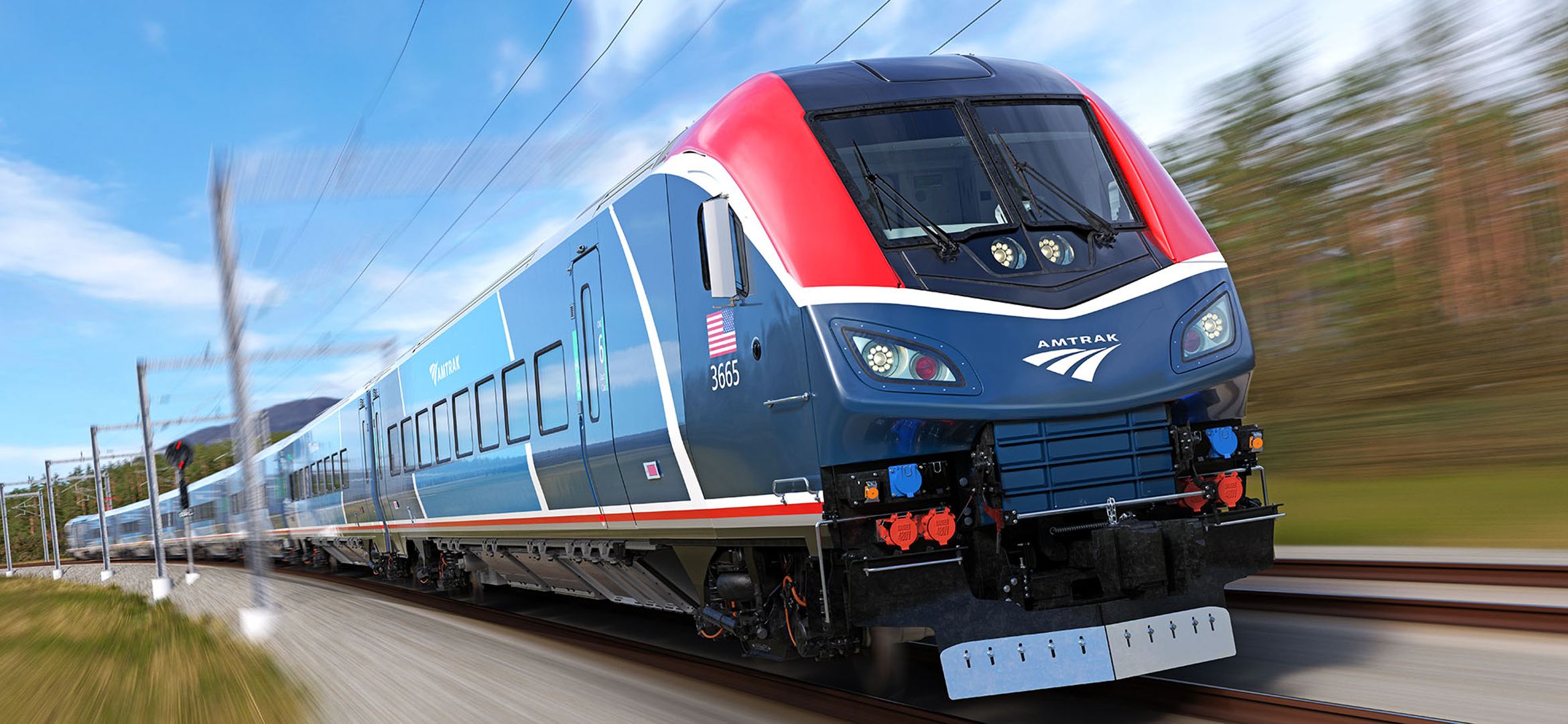
IMAGE CREDIT: Amtrak and Siemens Mobility
Rail Funding Moving Forward
Now there are many things for which a competitive grant program administered by the executive branch makes the most sense, but there are things for which it really in my opinion doesn’t, and this includes large Intercity and High-Speed Rail projects.
The fact is that there are only so many places where federal funding for passenger rail can effectively be spent, especially in billion-dollar amounts, unlike for example EV charging stations.
To start with, Amtrak regular issues reports on its infrastructure and rollingstock needs. Congress could block grant money to the national passenger railroad to upgrade stations to ADA standards, repair sideline damage equipment, and upgrade and build new maintenance facilities for new Airo trainsets. Essentially Congress already does this, which is why no President – Jimmy Carter, Ronald Reagon, or George W. Bush – has manage to defund or privatized Amtrak. It endures.
For new intercity rail mega-projects, there is no need for a competitive grant program administered by the Federal Railroad Administration – it just wastes time while placing the money at risk of being clawed-back by a future administration, as the Trump Administration has done with California High Speed Rail.
For the Biden Administration there was no need to wait in awarding $3 billion to the California High Speed Rail Project, $3 billion to Brightline West, $1 billion to North Carolina for the S-Line rebuilding, and $729 million to Virginia for the Long Bridge and DC-Richmond Third Track projects.
Outside the Northeast Corridor, there were at the time no other corridors could take in billions and actually spend it a few short years. And for smaller but significant intercity rail projects:
- Chicago Union Station Capacity-Expansion-Improvement Projects
- Maine Downeaster Corridor Track Improvement Project
- Livingston Ave Bridge Replacement Project
- Gulf Coast Mardi Gras Service Inauguration
- Montana Corridor Operational Enhancement Project
These could have been identified by Congress, by soliciting Amtrak and state DOTs, vetted by congressional staff, and then included in the bill as earmarks, directly funding them instead of requiring a grant application process.
Historically a lot of individual infrastructure projects have be directly approved and funded by specific acts on Congress – a few examples inckude the National Road, Transcontinental Railroad, Panama Canal, Alaskan Railroad, Hoover Dam, Grand Coulee Dam, St. Lawrence Seaway, and Dulles International Airport.
Congress should also consider providing enough funding to individual projects so that an entire intercity corridor upgrade or new high-speed rail line can be completed in about a decade. Providing the S-Line a billion is great, but how long will it be till more federal grant money is available?
We have seen that for passenger rail funding its been long periods of famine with short sporadic feasts when the alignment of a Democratic president and congress results in a few billion for passenger rail. Based on this fact, when the drought ends there should be a deluge of federal funding to allow ambitious rail projects to be undertaken and completed, instead of languishing till the next dollop of funding a decade later.
If you want results like Brightline in Florida between Miami and Orlando, brand new trains with high frequencies traveling at 90-to-125 mph, completed in ten years, then Brightline levels of funding are required, about $6-to-8 billion per corridor.
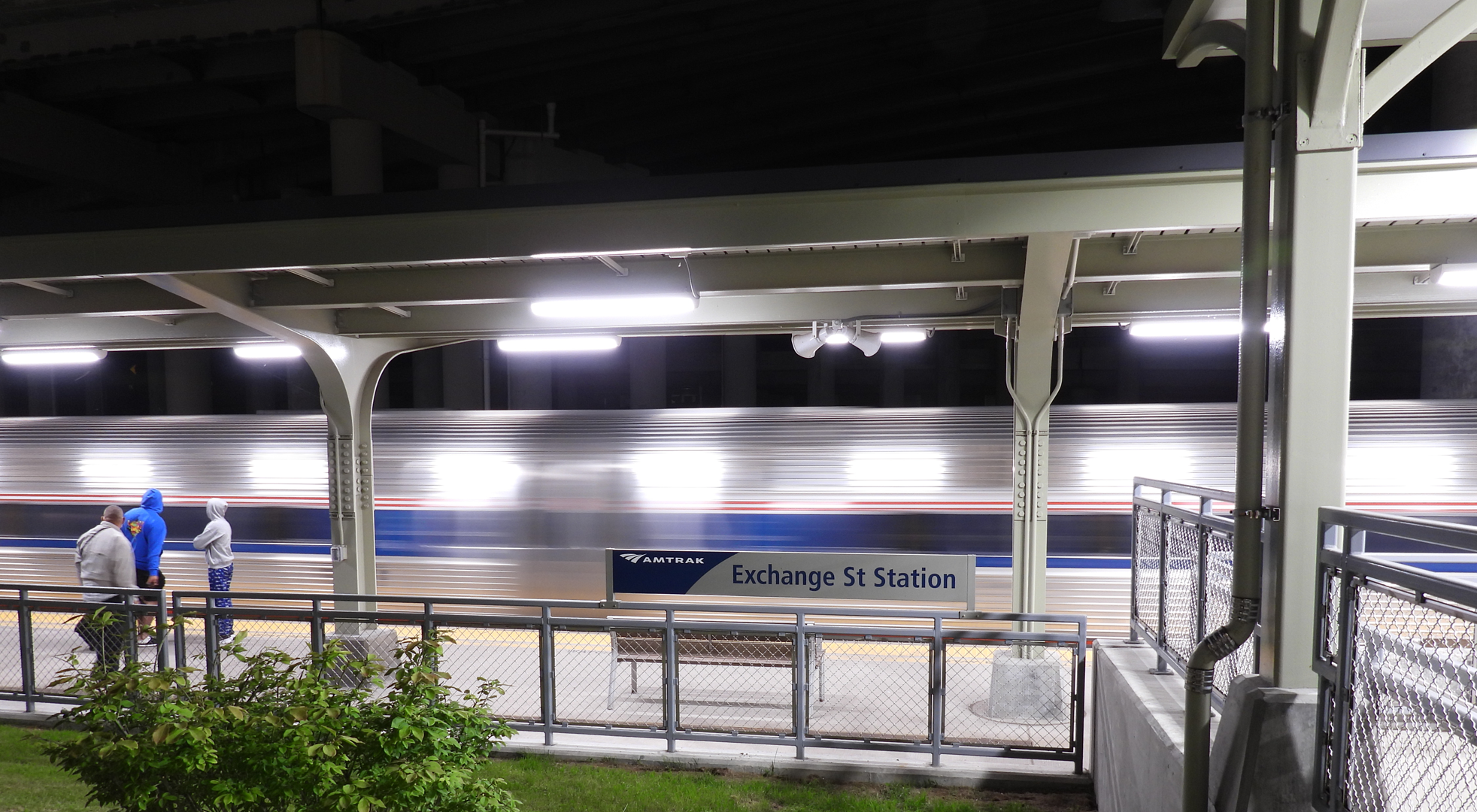
ABOVE: An example of an intercity rail project enterily paid for by the State of New York with no federal funds was the $29.8 million rebuilding of Buffalo Exchange Street, the design-build contract was awarded in December 2018 with the new station opening on November 8, 2020. PHOTO CREDIT: Benjamin Turon
Going it Alone
Another solution to intermittent and unpredictable nature of federal funding for passenger rail is for states to largely go it alone. Could most states fund a 220-MPH high-speed rail line by itself costing many tens if not hundreds of billions?
Likely not for the most part. However, “higher speed-frequency rail” services largely utilizing existing rail and highway right-of-way could be funded by many states, given that the most highly populated states with large economies have raised in recent decades several billions for other major infrastructure projects – for example major league sports stadiums.
New York State over the past two decades has provided several billions in public funding for semiconductor manufacturing in the Capital District and Central New York, for the Tesla Gigafactory in Buffalo, and new Buffalo Bills Highmark Stadium.
And now for the $5.5 billion proposed ‘Interborough Express’ (IBX) light rail line between Brooklyn and Queens the Metropolitan Transportation Agency (MTA) is looking at alternatives to federal funding, to avoid disruptions and costly delays imposed by an obstructing and vindictive administration in Washington.
“Normally a project of this magnitude, a brand-new rail line that will serve 160,000 to 200,000 people, would be federally funded — that’s the way it works in the United States of America,” MTA Chairman and CEO Janno Lieber told the MTA board’s capital construction committee in April. “We understand that opportunity may be a little bit of a lift for us, so we are developing different strategies to fund it.”
“We’re going to be ready to do construction in a couple of years. We want to make sure that we could move quickly into construction rather than waiting around for Santa Claus,” Lieber later told reporters. “It’s a strategy of optimistic realism. We’ll absolutely apply for federal money, but we are looking at alternatives in light of what we’ve seen about how discretionary grant money is being distributed in this administration. We’re not unrealistic about that.”
The IBX is currently in the design and engineering phase with a state-level environmental review underway – with an expected finish of both by the end of next year. A locally funded IBX would only require review under New York’s State Environmental Quality Review Act, rather than the federal National Environmental Policy Act. This could actually reduce costs, avoid delays due to litigation with the Trump administration, but at the potential cost of future federal grant money.
So – if the state could do this for a light-rail line, then why not for building a dedicated express track between Schenectady and Buffalo on the existing right-of-way of the former four-track mainline of the New York Central? Two or three billion would get several dozen miles of new third track built, new high-level platforms at stations, with reduced travel times and an increase frequency to a half-dozen daily passenger trains.
And the state embarking on such a project, building up the necessary in-house institutional capacity with project staffing, would actually make receiving federal money more likely in the future from the next administration.
During the Biden administration, outside the Northeast Corridor, the states and projects that got the most funding were those that were already underway while bringing a considerable amount of their own funding, and with sufficient organizational capacity to see the project to completion. This of course was California High Speed Rail, Brightline West, and Virginia and North Carolina with their various projects that comprise Southeast High-Speed Rail.
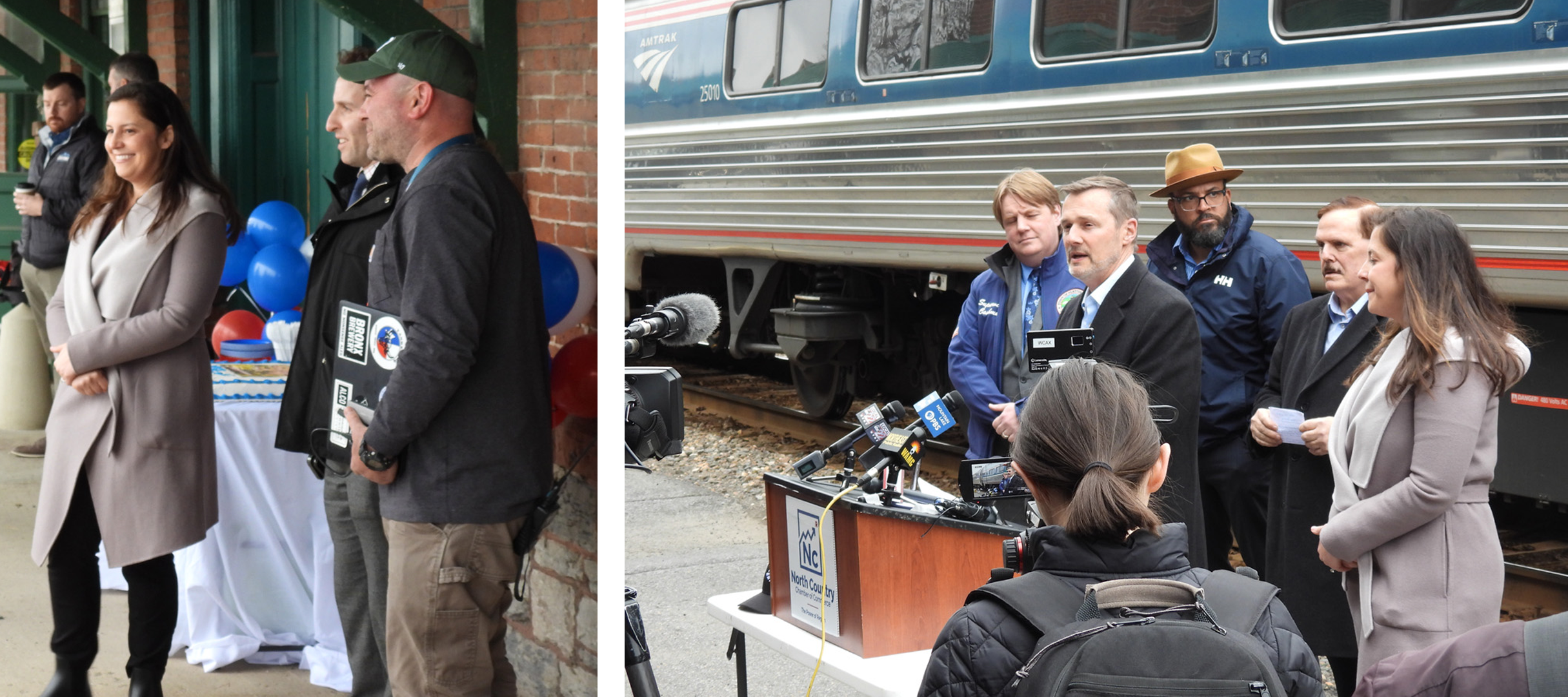
ABOVE: Representative Elise Stefanik (NY 21st Congressional District) in Plattsburgh welcoming the post-COVID return of the 'Adirondack' in April 2023. PHOTO CREDITS: Benjamin Turon
Afterword
This essay may have seem partisan – but I believe it merely reflects the facts as they are, that the current administration of Donald Trump is largely (but perhaps not entirely) hostile to passenger rail, although this of course is subject to change as this is an administration under Donald Trump.
Republican support for passenger rail exists across this great nation of ours, otherwise we wouldn’t the building out of new intercity rail infrastructure in services in the American South; in Louisiana, Mississippi, North Carolina, and Virginia. Passenger rail has long enjoyed Republican support in New York State; the good offices of retiring Congresswoman Elise Stefanik played a key role in post-COVID restoration of the ‘Adirondack’ service north of Albany to Montreal.
And the Trump Administration is moving forward with an actual sound plan to rebuild Penn Station, handing its oversight to “Train Daddy” Andy Byford, one of the most knowledgeable and respected rail transit officials in the Anglosphere, having run systems in London, Toronto, Sydney, before become a vice-president for high-speed rail at Amtrak, and now serving as the special advisor to the Amtrak Board of Directors for the redevelopment of New York Penn Station.
And the Trump administration in its first term was not wrong to point out the very high costs of rail transit projects in Blue State America. Many have, including the pages of the New York Times and reports issued by the NYU Marron Institute’s Transit Costs Project, idenitified and analyzed how New York City has become home by eye water amounts to the most expensive per mile rail transit projects in the world.
Perhaps the decades of steady and seemingly endless bounty of federal funding have made states both dependent and undisciplined when it comes to the planning, designing, building, and operation of rail transit systems.
Projects are often gold-plated, the perfect being the enemy of the good enough; with overstaffing by labor unions and overbidding by construction companies, and engineering firms; with public agencies lacking the proper staffing and institutional knowledge to maintain accountability and adherence to global best practices.
In other nations where money doesn’t grow on trees outside the Federal Reserve Bank, you see dollars pushed further, projects more carefully planned and design, which is why perhaps Morocco has High-Speed Rail, California as of yet does not.
Simply said, there is room for improvement. The current actions of the Trump administration are a challenge and an opportunity to do better with public transit and passenger rail at the federal, state, and local level. As always, please write to your state and federal lawmakers, the governor and the White House, to express your support for public transit and passenger rail.
Benjamin Turon
ESPA Vice-President