
April 1, 2026
Underway on Nuclear Power! Siemens to Build an Atomic Charger
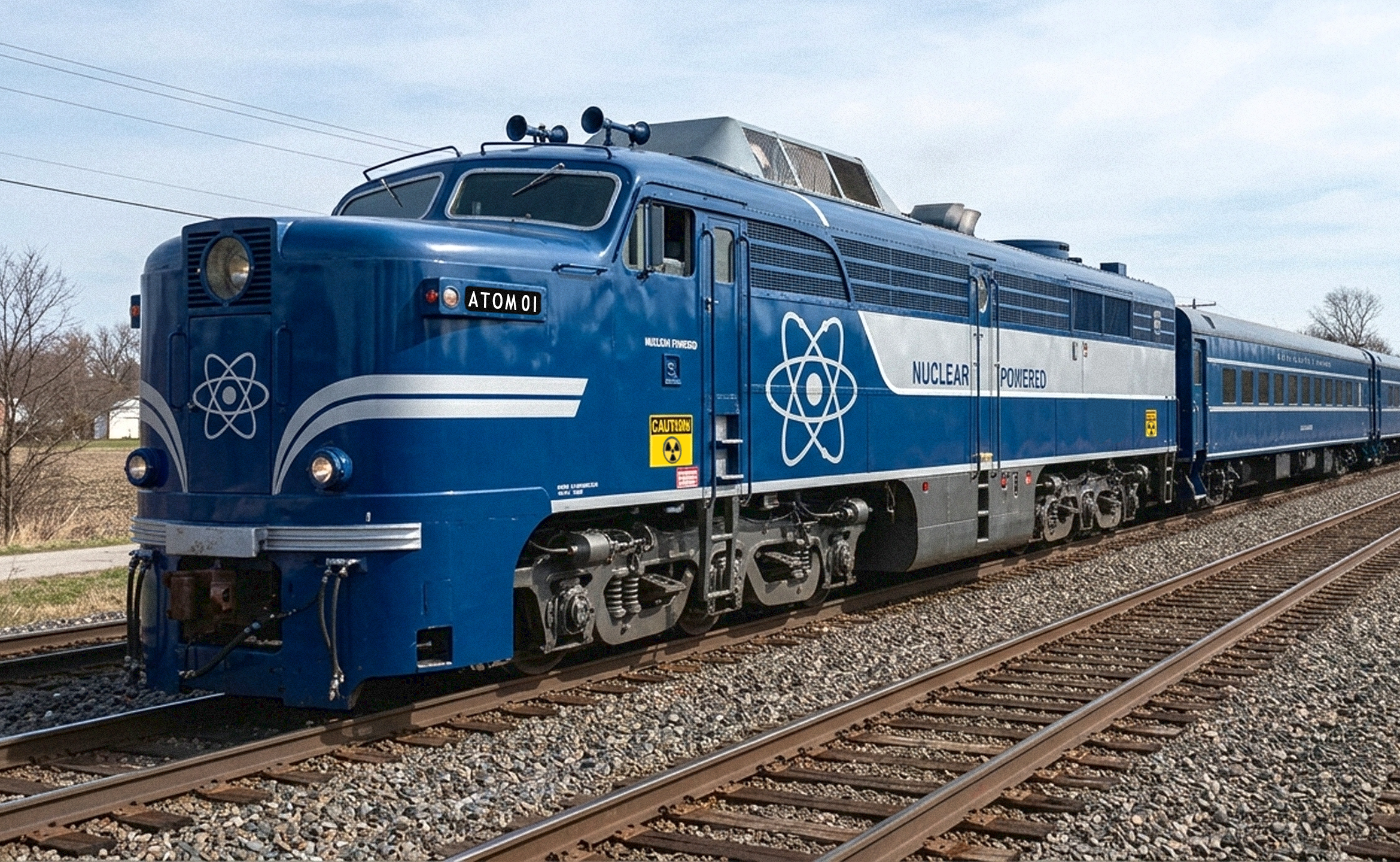
ABOVE: 'Atomic Jenny', a ALCO PA diesel locomotive converted into a nuclear locomotive prototype in Glenville, NY outside the Nova Atomic facility.
Underway on Nuclear Power!
Siemens Mobility to Build an Atomic Charger Locomotive
BY John B. Jervis for The Upstate Knickerbocker
April 1st, 2026
In a shocking announcement that nobody in the North American rail industry saw coming, Siemens Mobility announced a partnership with Nova Atomics of Glenville, NY, on building a nuclear-powered microreactor variant of their Charger locomotive family.
Yesterday (March 31st) was a cold and blustery day in Upstate NY, as a late afternoon press conference began at the Nova Atomics research and development facility in the Glenville Business and Technology Park, outside Schenectady NY.
Martin McFox, the North American Director of Product Development for Siemens Mobility, stood next to Doctor Emmett “Doc” Green, founder of Nova Atomics, on a small wooden podium outside a large corrugated metal building.
Doc Green pushed a big red button on a controller, triggering the slow opening of the sliding doors of an industrial building, as the front of a blue liveried locomotive with an atom logo, rolled out to the fanfare of ‘Also sprach Zarathustra’ by Richard Strauss.
“Behold!” exclaimed Doc Green to scattered applause. “The future of rail transport!”
What stood before the gathering was an ancient ALCO PA locomotive, manufactured across the river in Schenectady by the American Locomotive Company (ALCO) in 1953 for the Nickel Plate Road, before being sold to the Ferrocarriles Nacionales de México (N de M).
Acquired by Doc Green from a Mexican scrap yard thirty years ago in hopes of restoration, he instead has used it as the prototype for a nuclear-powered locomotive.
“When I asked him why the PA,” explained Mr. McFox, “Doc said to me: ‘if you’re going to build an atomic loco, why not do it with some style!’”
With a laugh Doc Green added: “When I brought Marty out last April, he couldn’t believe what I had done.”
“He yelled at me: ‘Doc, you mean this thing is nuclear!’ And I replied: ‘No-no, this thing is atomic-electric! With a three-megawatt microreactor generating the necessary electricity for the traction motors and head-end power.’”
“Yeah, real heavy!” added Mr. McFox. “But after a while I decided that Doc here really had something that Siemens should take a serious look at as we diversified the powertrains of the Charger platform from diesel-electric to dual-mode variants utilizing DC third rail, AC catenary, and battery.”
An atomic microreactor locomotive will be only the latest of the several different motive-power variants of the Siemens Charger family of locomotives, which hual passenger trains for two dozen commuter and intercity railroads, including Amtrak, VIA Rail, Brightline, and Metro-North.
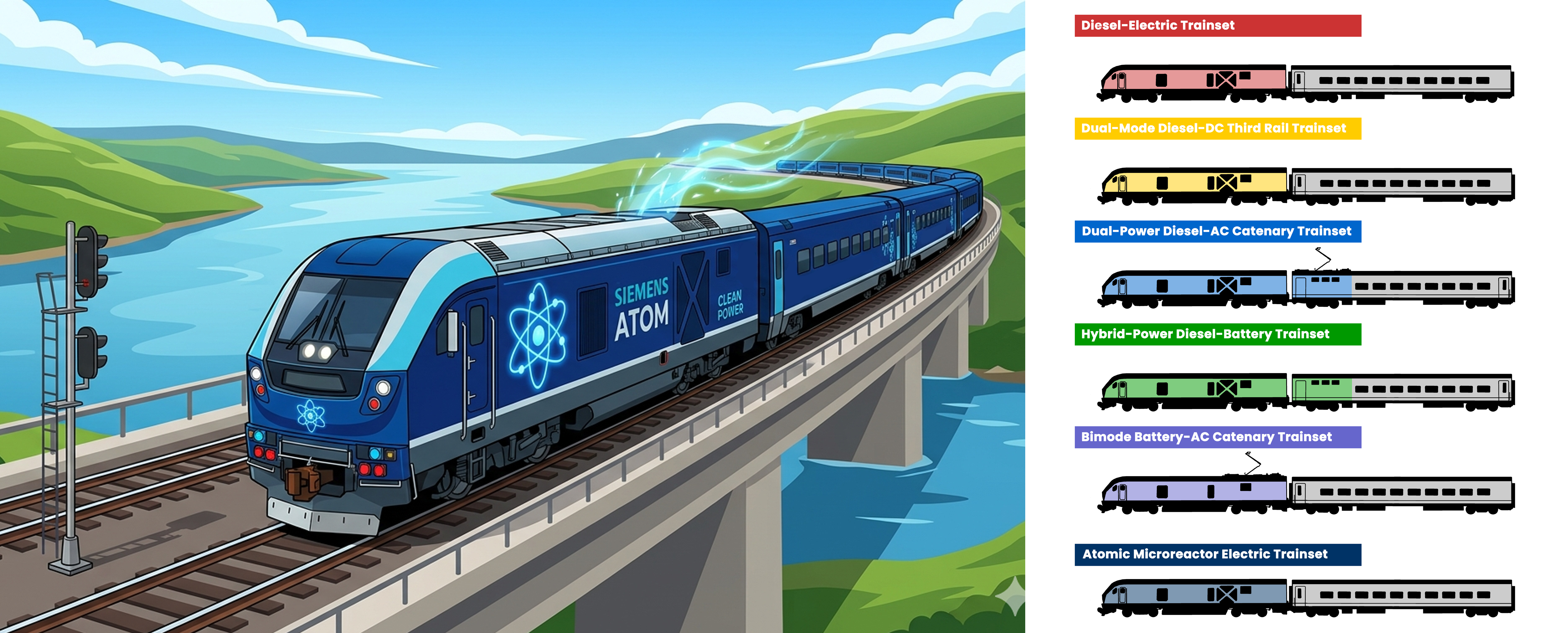
ABOVE: An atomic microreactor locomotive will be only the latest of the several different motive-power variants of the Siemens Charger family of locomotives hauling intercity and commuter passenger trains across North America.
The next step is for the prototype PA, nicknamed Atomic Jenney, is test runs on the mainline, followed by the construction of a second prototype in the bodyshell of a standard Siemens Charger diesel-electric locomotive.
“The plan is to have a NA Model 2T microreactor, which currently powers the PA, transported to our new facility in Horseheads, NY,” explained Mr. McFox, “where it will be installed into a Charger locomotive with the diesel prime mover removed.
“The rest of the locomotive remains largely unchanged, the traction motors, braking, and control cab. The fuel tanks will be replaced with a battery stack. A bank of superchargers will also be included within the bodyshell.
“The locomotive will emit no air pollution or greenhouse gases, and need refueling once a decade, so only once in a planned 20-year lifespan. They will be immune from wild price swings in fossil fuels, a benefit we can all greatly appreciate today.”
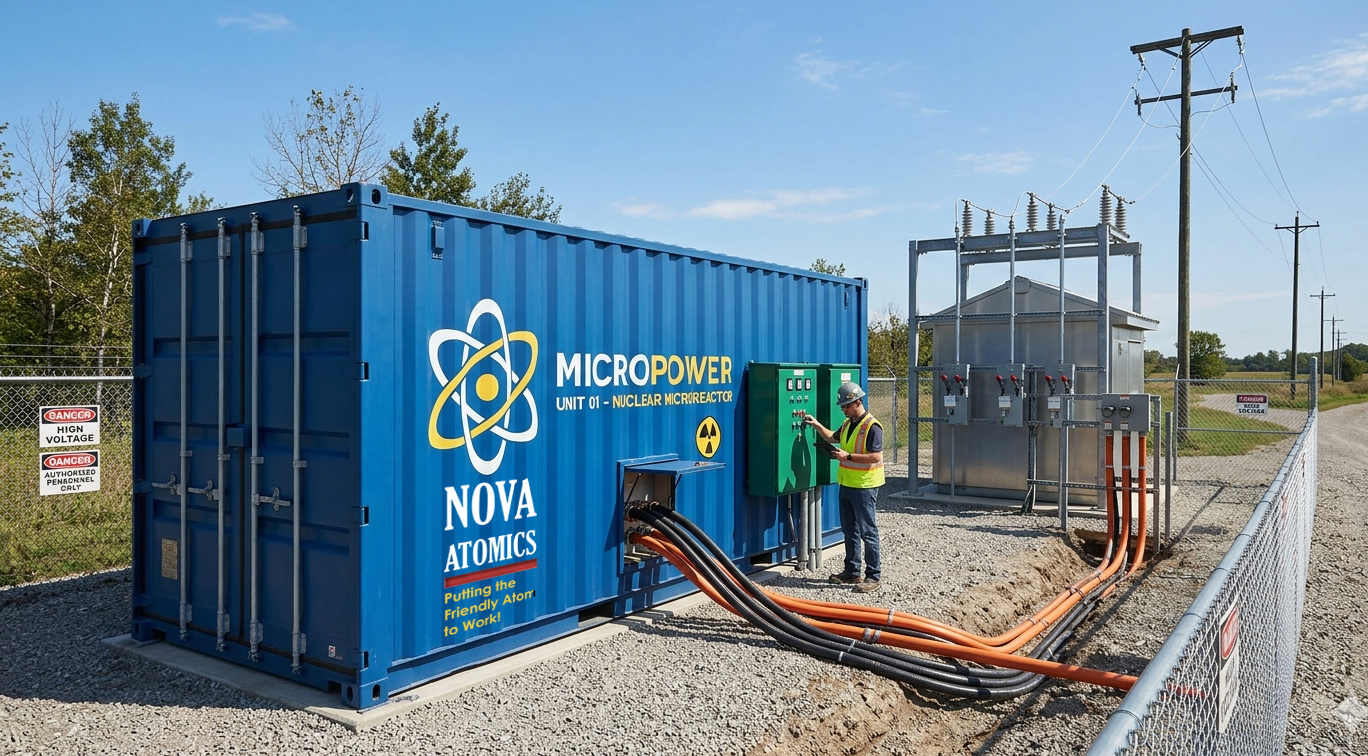
ABOVE: A demonstration one megawatt Model 1G nuclear microreactor on the Nova Atomics site in Glenville, NY.
Nova Atomics was founded by Doc Green in 2012 after thirty years at the Knolls Atomic Power Laboratory (KAPL) in Niskayuna. There he worked on research and development of next generation nuclear reactors for the US Navy, including a high-temperature gas microreactor for a nuclear torpedo codenamed “Big Splash”.
“My dad worked on these types of projects his whole professional life” reminisced Doc Green. “I’ve been carrying on his legacy.”
“He started out at the Manhattan Project as a junior researcher, and worked on various projects including Project Pluto to develop nuclear cruise missiles and Project Rover to develop a nuclear thermal rocket.
“His last was Project Longshot, an effort by NASA and the US Naval Academy to design an interstellar probe. He also was a scientific consultant for the Hollywood disaster film ‘The Big Bus’ and the NBC television series ‘Supertrain’.”
Questions of safety were foremost among the press gathered, but Doc Green expressed confidence in the crashworthiness of his microreactor design.
“As part of the safety reviews and tests of our standard product, the Model 2C, a portable microreactor in a shipping container,” stated Doc Green, “we are confident in the integrity of the reactor vessel in a high-speed crash.”
Goldie Wilson, former mayor of Fonda, NY and current board member from the New York State Energy Research and Development Authority (NYSERDA), which has funded Nova Atomics with several past grants, expressed optimism for the project.
“Given that you could place the microreactor in a shipping container and launch it into orbit, a locomotive is a natural fit. Just drop in the power module and remove it when needed for maintenance and refueling.
“One of these running off the tracks and tipping over into the Mohawk River is going to be a far lesser environmental emergency than a conventional locomotive spilling diesel fuel.”
George Tannen, the Assistant Commissioner for Decarbonization Initiatives from the New York State Department of Transportation, answering a question from a Popular Mechanics writer on the merits of rail electrification compared to nuclear locomotives stated:
“Yes, direct electrification with overhead catenary would be the most logical solution to getting our rail system to net-zero emissions, but opposition by the host freight railroads, and lack of federal funding available, makes a solution like this very attractive. With our mandate from Governor Caitlin Yokel’s pragmatic decarbonization agenda—”
Mr. Tannen was then interrupted by a railfan, known as a “foamer” in the rail industry, who vigorously disagreed.
“Just electrify man,” cried Biff Glover of Rotterdam, NY. “The rest of the world has done this, from Morocco to Malaysia. France powers the TGV with centralized nuclear power via the utility transmission system and then overhead catenary. It’s not that hard, man!”
While Messrs. Wilson, Tannen, and Glover noisily debated the merits of catenary verse battery verse renewable diesel verse electro-fuels for low-carbon railway motive power — the small crowd melted away, while 'Atomic Jenny’ gently rolled back into her domicile, the doors slowly closing to the strains of ‘Con te partirò’ sung by Italian tenor Andrea Bocelli.
The sun on the last day in March was setting, with another April First, another April Fools’ Day ahead.
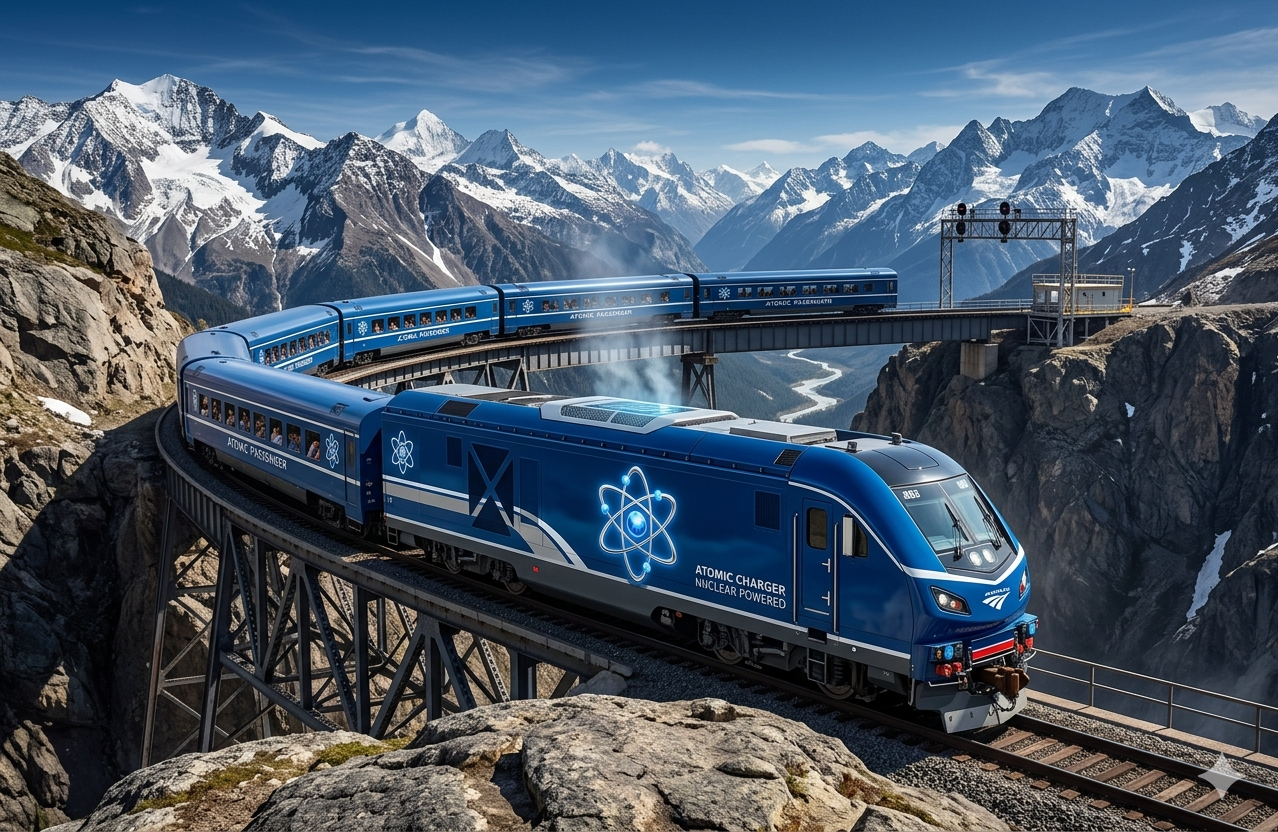
BELOW: Computer rendering of future Atomic Microreactor Charger locomotive hauling passenger train through the Rocky Mountains.
Curious Droid | Nuclear powered Planes, Trains and Automobiles

JetTrain Reaches Twenty Years in Service
BY John B. Jervis for The Upstate Knickerbocker
April 1st 2025
This Tuesday marks a full two decades since the Bombardier JetTrain entered commercial service, and to mark the occasion a large group of railfans—joined by a few former railroad, corporate, and public officials—are taking the early morning Acela Express ride down from the Rensselaer Rail Station to New York City, Philadelphia, Baltimore, Washington, and Richmond...